Creates a new virtual sensor on locality/logger in the myClim object.
Values are computed by a user-defined function or an expression evaluated on
a data table containing datetime and sensor columns.
mc_calc_custom(
  data,
  custom_function,
  output_sensor,
  output_sensor_id = NULL,
  logger_type = NULL,
  localities = NULL,
  sensors = NULL
)
Arguments
- data
cleaned myClim object see myClim-package
- custom_function
Function or unquoted expression defining the calculation.
Function (named or anonymous): first argument is
data_table(tibble withdatetimeand sensor columns); must return a vector oflogical,integer, ornumeric. ReturnNULLto skip the item.Expression: unquoted R expression referencing sensor names as variables (e.g.
TMS_T1 - TMS_T3,mean(TMS_T1)). Evaluated per locality/logger usingrlang::eval_tidy().
- output_sensor
Name of the newly created virtual sensor.
- output_sensor_id
Output sensor_id (optional). If NULL (default), sensor_id is inferred from custom function output type (
logical,integer,real). Must be one ofnames(mc_data_sensors)when provided.- logger_type
Logger type filter (optional). Character vector of logger types to process (e.g.
c("TMS","Thermo")) In raw format this filters loggers; in agg format it determines defaultsensorswhensensors=NULL.- localities
Character vector of
locality_ids to process.NULL(default) processes all localities.- sensors
Character vector of sensor names that must all be present in a logger/locality for processing to occur. Items missing any of these sensors are silently skipped.
NULL(default) disables this check.
Value
The input myClim object with the new virtual sensor output_sensor added to
all eligible localities/loggers.
Details
The user function receives a tibble with columns datetime and one column per
sensor present at each logger (raw format) or locality (agg format).
It must return a logical/integer/numeric vector with the same length as number of rows.
To skip loggers/localities without sensors used in custom function, use the sensors parameter.
When custom function is provided as an unquoted expression (as in dplyr::mutate()),
it is evaluated by rlang::eval_tidy() with the data table as data mask, so sensor
names can be used directly (e.g. TMS_T1 - 2 * TMS_T3). Pronouns .data and .env
are available to distinguish sensor columns from variables in the calling environment
(e.g. .data$TMS_T1 - .env$offset). Standard R functions
(mean(), dplyr::lag(), abs(), etc.) are available. If the calculation fails
(e.g. a referenced sensor is missing), the function stops with an error naming the locality
(and logger in raw format). Use sensors parameter to skip loggers/localities without required sensors.
Examples
# Function form - calculate difference between air and soil temperature
diff_func <- function(data_table) {
data_table$TMS_T1 - data_table$TMS_T3
}
data_diff <- mc_calc_custom(
mc_data_example_clean,
custom_function = diff_func,
output_sensor = "DIFF_T1_T3",
output_sensor_id = "T_C",
logger_type = "TMS",
sensors = c("TMS_T1", "TMS_T3")
)
# \donttest{
mc_plot_line(data_diff, sensors = c("DIFF_T1_T3","TMS_T1","TMS_T3"))
 # }
# Expression form - equivalent result
data_diff <- mc_calc_custom(
mc_data_example_clean,
custom_function = TMS_T1 - TMS_T3,
output_sensor = "DIFF_T1_T3",
output_sensor_id = "T_C",
logger_type = "TMS",
sensors = c("TMS_T1", "TMS_T3")
)
# \donttest{
mc_plot_line(data_diff, sensors = c("DIFF_T1_T3","TMS_T1","TMS_T3"))
 # }
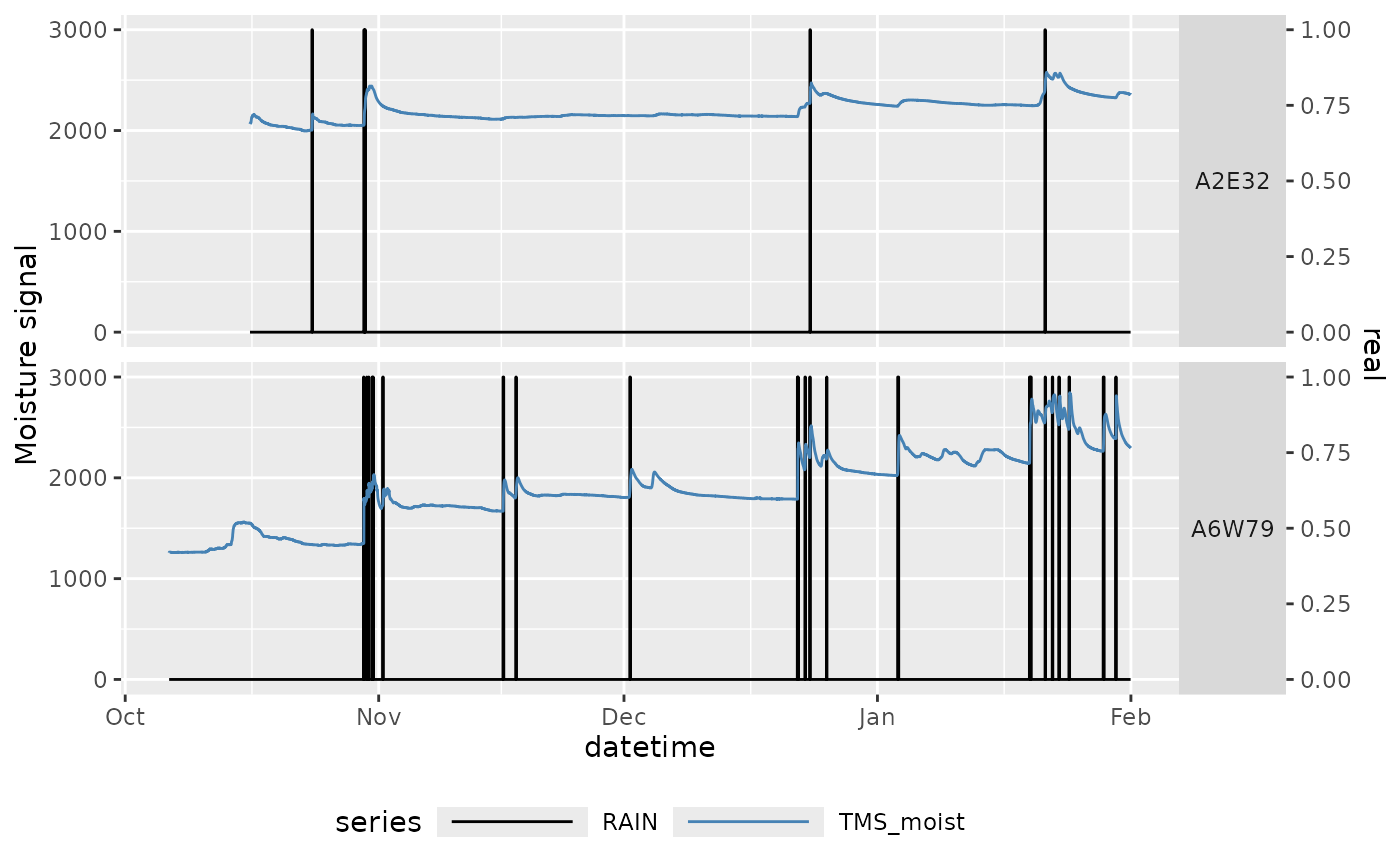
# Expression form - identify rain events based on TMS moisture sensor
# (moisture increase > 50 units within 4 consecutive measurements)
rain_event <- mc_calc_custom(
mc_data_example_clean,
custom_function = ifelse(dplyr::lead(TMS_moist, 4) - TMS_moist > 50, 1, 0),
output_sensor = "RAIN",
sensors = c("TMS_moist")
)
# \donttest{
mc_plot_line(rain_event, sensors = c("TMS_moist","RAIN"))
#> Warning: Removed 8 rows containing missing values or values outside the scale range
#> (`geom_line()`).
 # }